数学模型(核心思想)Math Model (Core Concept)
2.1 基本想法2.1 The Basic Idea
我们要做的事情很简单:What we're doing is simple:
- 每隔很短的时间(5 毫秒),读一次传感器Every short interval (5 milliseconds), read the sensors
- 算出这段时间里机器人移动了多少Calculate how much the robot moved during that time
- 把移动量加到之前的位置上Add the movement to the previous position
反复执行这个过程,就能一直知道机器人在哪里。By repeating this process, we always know where the robot is.
2.2 直线情况(简单)2.2 Straight Line Case (Simple)
如果机器人走直线,没有转弯:If the robot moves in a straight line without turning:
       前 (y+)
       ↑
       |  竖轮走了 Δv
       |
  ← ──┼── → (x+)
横轮走了 Δh
Δx = Δh(横向移动 = 横轮走的距离) (lateral movement = horizontal wheel distance)Δy = Δv(纵向移动 = 竖轮走的距离) (longitudinal movement = vertical wheel distance)
这很直觉。但机器人大部分时间不是走直线,而是在转弯。This is intuitive. But most of the time, the robot isn't going straight — it's turning.
2.3 从直线到弧线的过渡2.3 From Straight Lines to Arcs
想象一下:机器人不是走完美直线,而是一边走一边微微右转。Imagine: the robot isn't going perfectly straight, but slightly turning right as it moves.
- 如果转了 0.1 度 —— 几乎是直线,Δv 和 Δh 直接当位移用也差不多If it turned 0.1° — nearly straight, using Δv and Δh directly as displacement is close enough
- 如果转了 5 度 —— 有点弯了,直接用 Δv 当 y 位移就不太准了If it turned 5° — it's curving a bit, using Δv directly as y displacement is less accurate
- 如果转了 90 度 —— 明显是弧线,必须用更精确的方法If it turned 90° — clearly an arc, must use a more precise method
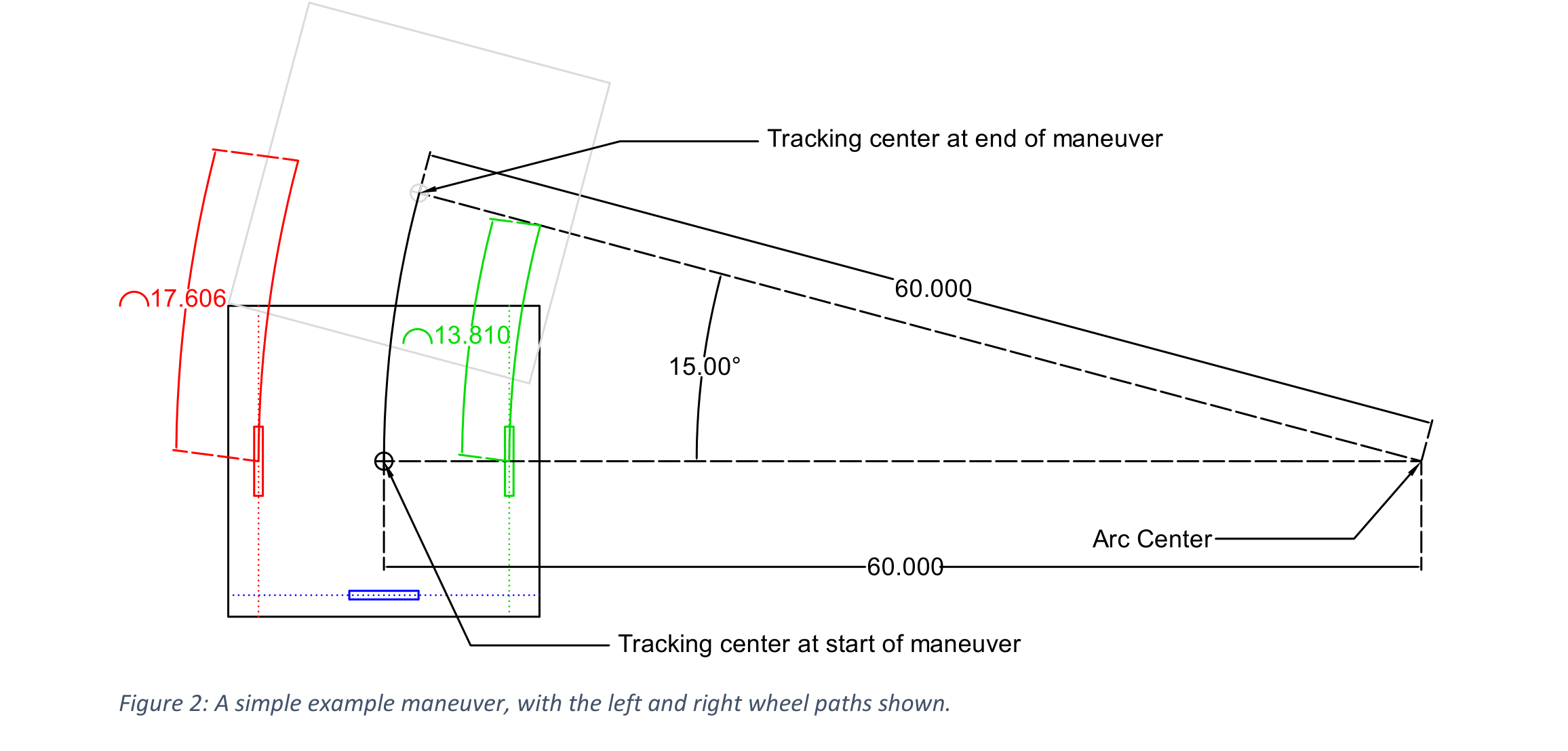
弧线越弯,弧长和位移的差距越大。所以我们需要一个方法,把弧长转换成位移。The more the arc curves, the bigger the difference between arc length and displacement. So we need a method to convert arc length into displacement.
2.4 转弯情况(圆弧模型)2.4 Turning Case (Circular Arc Model)
关键假设:在很短的时间内,机器人的运动轨迹可以看作一段圆弧。Key assumption: over a very short time, the robot's path can be approximated as a circular arc.
为什么?因为两边电机功率不同,机器人会绕一个点画弧线。时间越短,这个假设越准确。Why? Because different motor power on each side makes the robot curve around a point. The shorter the time interval, the more accurate this assumption.
         B (新位置)
        ╱
      ╱  弦长(我们要求的位移)
    ╱
  A (旧位置)
   \
    \  半径 R
     \
      O (圆心)

角度变化 = Δθ(陀螺仪告诉我们的)
弧长 = 定位轮走的距离推导过程(不需要背,理解思路就好):Derivation (no need to memorize, just understand the approach):
- 陀螺仪告诉我们角度变了
ΔθThe gyroscope tells us the angle changed byΔθ - 竖轮告诉我们走了弧长
弧长vThe vertical wheel tells us the arc lengtharc_v - 圆弧公式:弧长 = 半径 × 角度,所以
半径 = 弧长v ÷ ΔθArc formula: arc length = radius × angle, soradius = arc_v ÷ Δθ - 弦长公式(几何):
弦长 = 2 × 半径 × sin(Δθ/2)Chord formula (geometry):chord = 2 × radius × sin(Δθ/2) - 弦长就是实际位移,再分解到 x 和 y 方向The chord is the actual displacement, then decomposed into x and y directions
第 5 步为什么要"分解"? 因为机器人是斜着走的(一边前进一边转弯),位移不是纯 x 或纯 y 方向,需要用三角函数拆成两个分量。用的角度是这段时间的平均朝向 θ旧 + Δθ/2(起点和终点的中间值)。Why "decompose" in step 5? Because the robot moves diagonally (moving forward while turning), the displacement isn't purely in x or y — we need trig to split it into two components. The angle used is the average heading during the interval: θ_old + Δθ/2 (midpoint between start and end).
Δy = 弦长v × cos(平均角度) - 弦长h × sin(平均角度)Δy = chord_v × cos(avg_angle) - chord_h × sin(avg_angle)
为什么是 sin 和 cos 这样搭配?Why this sin/cos pairing? 这其实是"旋转矩阵" —— 把机器人视角的前后左右,转换成场地视角的 x 和 y。车头朝前(y+方向)时,前进 = y 增加,所以竖轮对 y 的贡献用 cos(cos(0)=1);前进不改变 x,所以竖轮对 x 的贡献用 sin(sin(0)=0)。转了角度之后,cos 和 sin 的值随之变化,自动完成了坐标转换。This is actually a "rotation matrix" — converting the robot's local forward/sideways into field-frame x and y. When heading forward (y+ direction), moving forward = y increases, so the vertical wheel's y contribution uses cos (cos(0)=1); forward movement doesn't change x, so the vertical wheel's x contribution uses sin (sin(0)=0). As the angle changes, cos and sin values change accordingly, automatically handling the coordinate conversion.
机器人走了 10cm,拖动角度看 Δx 和 Δy 怎么变The robot moves 10cm — drag the angle to see how Δx and Δy change
0° = 正前方,90° = 正右方0° = straight ahead, 90° = directly right
红色Red = x 分量component,绿色Green = y 分量component
2.5 偏移补正2.5 Offset Correction
理想情况下,竖轮应该装在机器人的旋转中心上。但实际上很难做到,轮子往往偏了一点。Ideally, the vertical wheel should be mounted at the robot's center of rotation. But in practice that's hard to achieve — the wheel is usually offset a bit.
偏移会导致:机器人原地转圈时,定位轮也会走一段弧,程序误以为机器人移动了。This offset causes a problem: when the robot spins in place, the tracking wheel travels along an arc, making the program think the robot has moved.
补正方法:在计算半径时,加上定位轮到旋转中心的偏移距离。Correction method: add the tracking wheel's offset distance from the center of rotation when calculating the radius.
这个偏移距离需要量出来(后面会讲怎么测量)。This offset distance needs to be measured (we'll cover how to measure it later).